


 0.00
what does that mean?
0.00
what does that mean?
Add to Stack
85,253 words
Synopsis
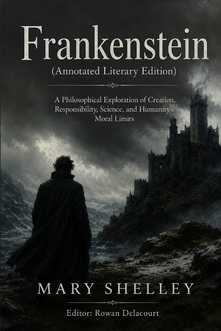
This fully annotated edition of “Frankenstein (Annotated Literary Edition)” includes:
Clear philosophical and ethical annotations throughout the text
Detailed literary analysis of Gothic themes and narrative structure
Historical context of 19th-century science and Romantic thought
Character insights into Victor Frankenstein and the Creature
Guided commentary on morality, responsibility, and creation
Frankenstein (Annotated Literary Edition) is a deeply enriched version of Mary Shelley’s classic novel that explores the boundaries of science, morality, and human responsibility. This edition preserves the original text while adding structured annotations that help readers understand the philosophical, literary, and ethical dimensions of the story.
Set against the backdrop of Romantic-era scientific curiosity, the novel follows Victor Frankenstein’s experiment in creating life and the devastating consequences that follow. Through this annotated edition, readers gain deeper insight into the psychological collapse of Victor, the emotional and intellectual development of the Creature, and the moral questions surrounding creation without responsibility.
Each chapter is supported with carefully designed commentary that explains symbolism, thematic development, and historical context without altering Shelley’s original language. The annotations guide readers through key ideas such as isolation, ambition, rejection, and the limits of human knowledge.
This edition is designed for students, scholars, and general readers who want to experience Frankenstein not only as a Gothic novel, but as a philosophical exploration of what it means to create, to suffer, and to be human.
Similar to this book




Story Elements
Setting
| Geography: | Berlin |
|---|---|
| Realism: | Consistent with real world, no magic, no unachieved science |
| Setting Type: | Urban (city) |
| Time Period: | 1800 - 1899 |
Main Character
| Age: | Adult |
|---|---|
| Gender: | Male |
| Race: | Caucasian European |
| Religion: | Christian |
| Sexual Preference: | Irrelevant or N/A |
Styles & Themes
| Humor: | Moments of levity |
|---|---|
| Inspires Reader to Feel: | Uneasy/Tense |
| Mysteries & Puzzles: | Significant mystery(ies) are core to driving the story |
| Pacing: | Time to savor, deliberate |
| Physical Action: | Nature-based survival action |
| Political/Social Commentary: | Story includes metaphors for social or political theme(s) |
| Romance: | Minor romance, not a significant story driver |
| Genre | Mystery |
|---|---|
| Mysteries & Puzzles: |
|
About the author

Mary Shelley
Mary Shelley (1797–1851) was an English novelist, essayist, and one of the most influential writers of the Romantic era. She was the daughter of philosopher William Godwin and pioneering feminist writer Mary Wollstonecraft. Shelley is best known as the author of Frankenstein; or, The Modern Prometheus, first published in 1818. She wrote the novel at a young age, creating one of the earliest and most enduring works of science fiction and Gothic literature. Her writing explored themes of creation, responsibility, scientific ambition, identity, and human isolation. Shelley was closely connected with the literary circles of nineteenth-century England and Europe. Her marriage to the poet Percy Bysshe Shelley influenced her intellectual and creative development. Beyond Frankenstein, she wrote several novels, travel writings, biographies, and essays. Her works continue to be studied for their philosophical depth and exploration of social and ethical questions. Today, Mary Shelley is recognized as a pioneering figure whose ideas remain relevant in modern discussions of science, technology, and humanity.